 EN
EN

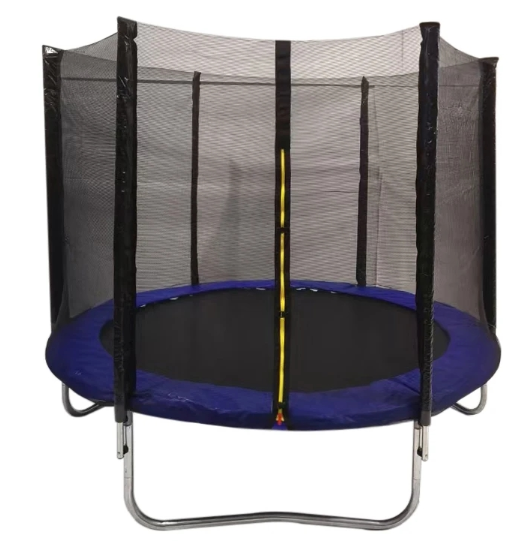
Polypropylene: The Industry-Standard Material for Safe and Wear-Resistant Trampoline Mats
UV-stabilized woven polypropylene: Why it dominates commercial and residential trampoline mat design
When it comes to trampoline mats, UV stabilized woven polypropylene has pretty much taken over as the go-to material these days. People love it because it just plain lasts longer than other options, stands up to all kinds of weather, and keeps performing consistently year after year. Regular plastics without those special additives tend to break down fast under sunlight. The good stuff gets treated with UV inhibitors right during manufacturing, which stops those harmful rays from making fibers brittle or causing colors to fade away. Tests following ISO standards show that quality UV protected polypropylene maintains around 92% of its strength even after being blasted with artificial sunlight for 3,000 hours something that would take about seven years outdoors. The way it's woven also helps fight off water damage, wind wear, and temperature changes while still giving that reliable bounce everyone wants. Combine all these factors chemical stability, solid construction, and consistent energy transfer and it's no wonder this material shows up everywhere from backyard setups to professional facilities. Studies back up what many already know the UV protection in polypropylene really does make these trampolines last much longer than alternatives.
Tensile strength, elongation, and impact absorption: How polypropylene performs under real-world jump cycles
Polypropylene excels in the three mechanical properties most critical to trampoline safety and performance:
- Tensile strength (45 MPa) resists tearing during dynamic loading, even with aggressive or off-center landings
- Controlled elongation (15–30%) enables efficient energy storage and return—delivering responsive, fatigue-resistant rebound
- Impact absorption, validated by ASTM F2970 drop tests, dissipates up to 85% of kinetic energy on landing—reducing peak joint forces and injury risk
Its semi-crystalline molecular structure provides elastic memory: fibers deform temporarily under load but fully recover without permanent set. In accelerated fatigue testing, premium polypropylene mats withstand over 50,000 jump cycles with minimal degradation—maintaining consistent bounce height and surface integrity year after year.
Key Durability Metrics: UV Resistance, Tear Strength, and Weather Resilience
Accelerated UV aging (ISO 4892-3) and long-term color/fiber integrity of trampoline mat materials
When it comes to outdoor trampoline mats, UV resistance simply cannot be ignored, and most experts still look to ISO 4892-3 accelerated aging tests as the gold standard. Good quality polypropylene materials tend to hold onto over 90% of their tensile strength even after spending more than 2,000 hours under UV light. They also keep their colors looking decent and maintain that nice flexible feel no matter if temperatures drop to -30 degrees Celsius or climb all the way to 50. What really matters though are those UV stabilizers fighting against something called photo-oxidative chain scission, which basically causes those annoying cracks and powdery surfaces we all hate seeing. Keeping fibers intact isn't just about looks either. Strong fibers mean better resistance to tears, stronger seams, and safer distribution of impact forces when kids jump around on the mat day after day.
Tear resistance (ASTM D1117) and structural fatigue resistance after 50,000+ simulated jumps
When talking about tear resistance, we look at ASTM D1117 standards. The best mats on the market hit around 40 N/mm or better, which means those little snags or scrapes don't turn into big rips down the road. Fatigue resistance matters just as much though. According to EN 71-14 regulations, trampolines need to survive over 50 thousand simulated jumps before they get certified for sale. After all these tests, what do we find? High density polypropylene only stretches about 5% permanently and keeps most of its original strength at the edges too. The reinforced edges and extra stitching along the seams actually help spread out the stress across the mat instead of letting it concentrate where the stitches might fail. This prevents those frustrating situations where parts of the mat start pulling through and creating dangerous weak spots.
Safety Compliance: How Regulatory Standards Validate Trampoline Mat Material Safety
REACH, EN 71-14, and ASTM F2970: Chemical safety, heavy metal limits, and mechanical performance benchmarks for trampoline mats
Trampoline mat safety is verified through a triad of globally recognized standards—each addressing a distinct risk vector:
- REACH compliance restricts hazardous substances—including lead, cadmium, and phthalates—to trace levels (<0.1%), ensuring direct skin contact poses no toxicological risk
- EN 71-14 validates long-term structural reliability via rigorous fatigue testing (50,000+ jumps), dimensional stability, and edge reinforcement requirements
- ASTM F2970-22 quantifies dynamic performance, mandating 60% kinetic energy absorption during standardized drop tests to mitigate impact-related injuries
Together, these standards form a comprehensive safety framework. Independent verification against all three correlates strongly with real-world outcomes: certified mats reduce fall-related injuries by up to 72% compared to non-compliant alternatives—confirming that regulatory alignment translates directly into safer, more reliable rebound experiences.
Construction Enhancements That Maximize Trampoline Mat Longevity and Safety
Reinforced perimeter binding, high-density weave, and double-stitched seam techniques for tear-resistant trampoline mats
Even the highest-grade polypropylene requires intelligent construction to deliver its full safety and longevity potential. Three engineering refinements are essential:
- Reinforced perimeter binding, typically using folded, heat-sealed tape or triple-layer webbing, redistributes landing stresses away from the outer seam—reducing edge-fraying failure rates by up to 70%
- High-density weave (8×8 threads/in²) increases fiber density without sacrificing flexibility, boosting tensile strength and enabling uniform force dispersion across the entire mat surface
- Double-stitched seams with UV-stabilized polyester thread create redundant tension points that resist pull-through under high-velocity landings—critical for maintaining structural continuity during peak-load events
These features don’t merely extend service life beyond 50,000 jumps—they actively prevent sudden, unpredictable fabric failures that could result in loss of control or uncontrolled ejection. When combined with UV-stabilized polypropylene, they deliver a mat that performs safely, predictably, and durably—season after season.
Table of Contents
- Polypropylene: The Industry-Standard Material for Safe and Wear-Resistant Trampoline Mats
- Key Durability Metrics: UV Resistance, Tear Strength, and Weather Resilience
- Safety Compliance: How Regulatory Standards Validate Trampoline Mat Material Safety
- Construction Enhancements That Maximize Trampoline Mat Longevity and Safety