 EN
EN

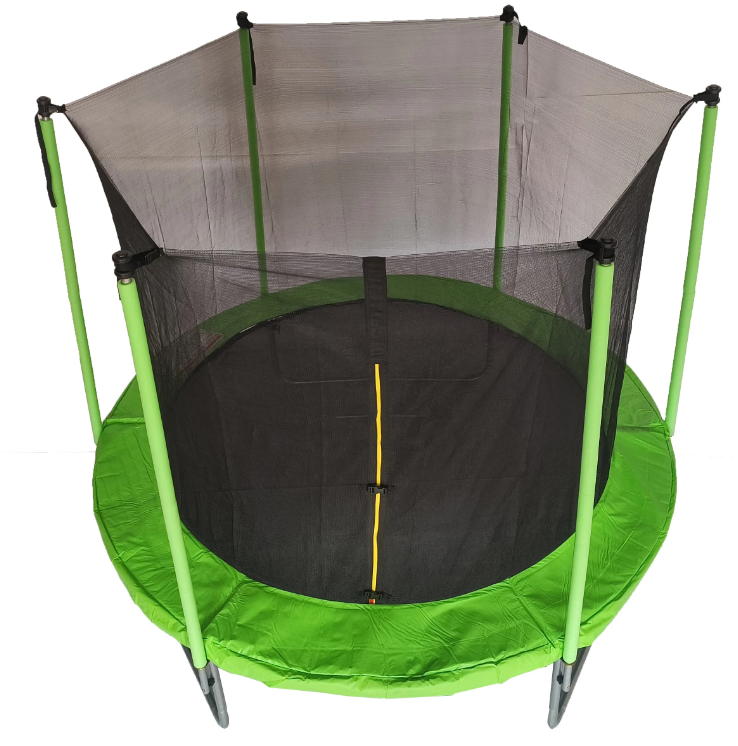
ASTM F2225-22: The Primary Standard for Trampoline with Net Enclosure Safety
Why Dedicated Net Standards Are Essential for Trampoline with Net Safety
Most general safety advice for trampolines doesn’t really consider the specific dangers associated with net enclosures. These include things like getting tangled in the netting, poles coming loose, or materials breaking down over time due to sun exposure. Looking at industry data, somewhere between 27 and 39 percent of all trampoline injuries happen when people fall off, which makes good quality safety nets absolutely essential for protection. There’s actually just one American standard called ASTM F2225-22 that was created specifically for net enclosures. This standard aims to stop falls while not creating other problems. It covers how strong the structure needs to be, how well it holds up against weather conditions, and how safe it stays during normal use by real people jumping around on it every day.
Key Requirements: Net Height, UV Resistance, Impact Absorption, and Bottom Connection Strength
ASTM F2225-22 establishes four non-negotiable performance pillars, each validated through third-party laboratory testing:
- Net Height: Minimum 90% of the intended user’s height to eliminate gaps that enable accidental egress
- UV Resistance: Net material must retain ≥80% tensile strength after 1,000+ hours of accelerated weathering (per ASTM G154)
- Impact Absorption: Must withstand dynamic loads of 250+ lbf without tearing, pole detachment, or frame deformation
-
Bottom Connection Strength: Anchors and attachment points must resist ≥50 lbf pull force to prevent ground-level entrapment hazards
Compliance requires documented certification—not just manufacturer self-declaration—to verify performance across weather exposure, repeated impact, and long-term mechanical stress.
Complementary ASTM Standards: Ensuring Full-System Integrity for Trampoline with Net
ASTM F381—22: Component-Level Testing for Net Fabric and Fasteners
The standard focuses on basic enclosure components first and foremost. For netting material, there’s a requirement for at least 50 pounds force tear resistance according to ASTM D5034 standards. Plus it needs to survive over 1000 hours under UV light exposure tests. When it comes to fasteners, they get tested twice over really. First, they have to hold up against pulls of more than 250 pounds force. Second, they must resist corrosion during 96 straight hours of salt spray exposure as per ASTM B117 guidelines. All these rigorous checks help keep each part working properly and staying put for the whole lifespan of the product. That matters especially when installed near coastlines where salt air hangs around, or anywhere with lots of sunshine beating down on them day after day.
ASTM F2970—22: Integrated Safety of Net, Poles, Padding, and Frame Stability
Standard F2970-22 looks at how different parts of enclosures work together as part of one complete system. The standard requires several key tests including applying 500 pounds of force laterally to poles, covering all joints with at least two inches of impact absorbing material, and making sure the connections between nets and poles can handle over ten thousand cycles of repeated stress without failing. Frame stability is tested too, with specifications limiting movement to three degrees maximum when subjected to uneven jumping forces. This helps avoid situations where structures might collapse, become misaligned, or sag dangerously low enough to fail in protecting against falls. By taking this comprehensive look at safety from multiple angles, manufacturers ensure there’s nothing in the design that acts as a potential failure point for the whole system.
EN 13219: International Benchmark for Trampoline with Net Compliance
Regulatory Relevance: Why EN 13219 Is Critical for EU Sales and Global Certification
The EN 13219 standard works alongside the EU’s General Product Safety Regulation (GPSR). For anyone selling trampolines with nets across the European Economic Area, following this regulation isn’t just good practice—it’s actually required by law. The standard mainly targets those big rectangular trampolines we see in places like gyms, physiotherapy centers, and athletic training spaces. When manufacturers meet these specs, they gain entry into what amounts to around 740 billion euros worth of sports gear sales throughout Europe according to Eurostat data from 2023. Plus, getting certified shows other international testing organizations that the product meets serious safety standards. Many of these groups now look at EN 13219 as an important benchmark when assessing how well protective enclosures perform.
Comparative Performance: EN 13219 vs. ASTM F2225 on Net Height, Force Thresholds, and Durability
EN 13219 reflects the higher performance expectations of commercial and elite-use environments—and accordingly sets more stringent benchmarks than ASTM F2225-22:
| Parameter | EN 13219 | ASTM F2225 |
|---|---|---|
| Net Impact Force | ≤ 6 kN | ≤ 8 kN |
| UV Resistance | 1500+ hours | 1000+ hours |
| Frame Load Test | 150% operational load | 125% operational load |
EN 13219 also requires net height minimums ~20% greater than F2225 to accommodate elite athletes’ extended airtime and bounce trajectories. Its durability protocols simulate over 10 years of intensive use and mandate reinforced stitching at all net-pole junctions—underscoring its focus on sustained reliability in demanding applications.
Practical Verification: How to Confirm Your Trampoline with Net Meets These Standards
Verifying compliance demands more than trusting marketing claims. Start by locating the official ASTM F2225-22 or EN 13219 certification label—legally required on compliant frames or net assemblies—and cross-reference it with the manufacturer’s publicly available technical documentation. Then conduct these targeted checks:
- Net Integrity: Confirm UV-resistance ratings meet or exceed 1,000 hours (F2225) or 1,500 hours (EN 13219); inspect mesh density to prevent finger or limb entrapment (≤6 mm aperture recommended)
- Structural Security: Gently test bottom net tension—no gap should allow lifting or sliding beneath it with moderate hand pressure
- Impact Resilience: Verify padding thickness is ≥20 mm at all contact zones, especially around support poles and frame joints
When looking at a trampoline enclosure and no certification is clearly displayed, it’s worth asking the seller or manufacturer for actual third party testing reports. Good quality brands usually have all their test results ready to show customers. These include things like how stable the net remains when someone jumps on it, what happens during drop tests measured in gravity units (around 5g or less is acceptable), and whether the safety components stay attached properly. The numbers tell an important story here too. According to research published in the Global Safety Report last year, trampolines without proper certification actually pose nearly half again as much risk for serious falls compared to those meeting ASTM standards. That’s pretty staggering when you think about it.
Table of Contents
- ASTM F2225-22: The Primary Standard for Trampoline with Net Enclosure Safety
- Complementary ASTM Standards: Ensuring Full-System Integrity for Trampoline with Net
- EN 13219: International Benchmark for Trampoline with Net Compliance
- Practical Verification: How to Confirm Your Trampoline with Net Meets These Standards